
What can I use for teeth while the implants heal?
Many options are available, tailored to your specific requirements. If you need a replacement tooth while the implants are healing, temporary removable teeth or a temporary bridge can be made. If all your teeth are missing, we can usually modify your present complete denture or make you a new temporary denture. If you would prefer non-removable teeth during the healing phase, temporary transitional implants can usually be placed along with the permanent implants, and temporary teeth may be fabricated and inserted the same day. Depending on your particular situation, some implants can be placed and “loaded” immediately. This means a temporary or permanent replacement tooth can be placed on the day the implant is placed, or shortly after.
What are the potential problems after dental implant surgery?
Although it is natural to be concerned about the pain that may be caused by these procedures, most patients do not experience severe or significant post-operative pain. Pain medication and antibiotics will be prescribed for you to make your recovery as easy as possible. Occasionally, some people develop post-operative infections that require additional antibiotic treatment. Even though great care is taken to place the implant precisely, adjacent teeth are occasionally injured during placement.
In addition, there is a chance that the nerve in the lower jaw, which provides sensation to your lower lip and chin, may be affected. If you are missing quite a lot of bone, it might be difficult to place an implant without infringing on the nerve space. Although we take great care to avoid this nerve, it’s occasionally irritated during the procedure, which can result in tingling, numbness, or a complete loss of sensation in your lip, chin, or tongue. Usually, these altered sensations will resolve over time, but they can be permanent and/or painful. If you notify us of post-operative numbness as soon as possible, it will allow us to manage your care in the most appropriate way.
How long will the implants last?
Implants usually last a long time. When patients are missing all of their teeth, long-term studies (more than 30 years) show an 80 to 90 percent success rate. For patients missing one or several teeth, recent studies show a success rate of more than 95 percent, which compares favorably with other areas of the body that receive implant replacement (such as the hips or knees). However, if one of your dental implants either doesn’t heal properly or loosens after a period of time, you may need to have it removed. After the site heals (or, on occasion, at the time of removal), another implant can usually be placed.
When are the replacement teeth attached to the implant?
The replacement teeth are usually attached to the implant when adequate healing has occurred, and your jawbone is firmly fused to the implant. Depending on various factors, you may be able to begin this phase of your treatment immediately or shortly after implant placement. We will review the most appropriate treatment sequence and timing for your particular situation.
The dental work required to complete your treatment is complex. Most of the work involves actually making the new teeth before they are placed. Your appointments are considered more comfortable and more pleasant than previous methods of tooth replacement. This process can often be performed without local anesthesia.
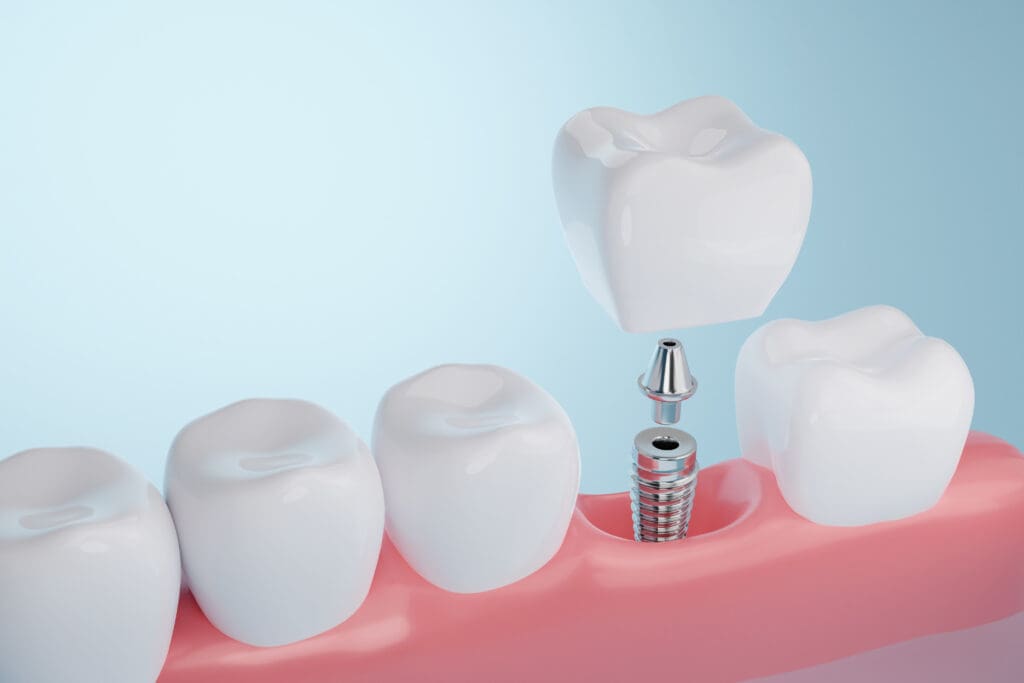
Your restorative treatment begins with specialized impressions that allow us to produce a replica of your mouth and implants. We will also take “bite” records to show the relationship between your upper and lower jaws. With this information, we will make the abutments (support posts) that attach your replacement teeth to your implants. Various types of abutments exist. Frequently, we can use “off the shelf” abutments. Other times, custom abutments must be made of gold or a tooth-colored ceramic material. As you can imagine, these custom-made abutments increase the cost and treatment time. Which abutment to use is a decision that often cannot be made until after healing is complete and impressions have been made.
The number of appointments and the amount of time required for each appointment is different for each patient. No two cases are exactly the same, and regardless of the number of teeth replaced, the work must be completed with great precision and attention to detail. If you are having only a few teeth replaced, as few as three short appointments may be required. Between appointments, we will need time to complete the necessary lab work to make your replacement teeth. It is most beneficial that you keep all of your scheduled appointments.
If your final restoration is a removable denture, you will need to come in for as many as five office appointments (though it may be fewer) over the following several months. During these appointments, we will take impressions, make bites, and perform adjustments to fabricate your new teeth, as well as the custom support bars, snaps, magnets, or clips that will secure your teeth to the dental implants. During this period, every effort will be made to ensure you have comfortable, temporary replacement teeth.
In general, once your implants are placed, you can expect your tooth replacement treatment to be completed anywhere from 1 to 12 months. For these reasons, it is difficult for us to tell you exactly how much the restorative phase of your treatment will cost, although you should receive a reasonable estimate from our office. It is also difficult to give you a specific timeframe for completion of your treatment until after the implants are ready for restoration.
How do I clean my new teeth?
As with natural teeth, it is important to clean implant-supported restorations regularly with toothbrushes, dental floss, and any other recommended aids. You should also visit your dentist several times each year for hygiene and maintenance. As with regular dentures and other tooth replacements, your dental implants and their associated components are subject to wear and tear and eventually will need repair, including clip replacement, relines, screw tightening, and other adjustments.
Will one doctor do everything?
Usually, a dental surgeon places the dental implant(s) and performs other necessary surgical procedures; your general dentist provides the temporary and permanent replacement teeth. Both doctors are involved in planning your dental treatment. Also, depending on various factors, different dental specialists may help with your dental care.
How much does dental implant treatment cost?
Before treatment begins, every effort will be made to provide you with an accurate estimate of all expenses involved in placing the implants and fabricating your replacement teeth. In many cases, there is an initial charge for the diagnostic work-up, including study models, x-rays, and the fabrication of a surgical template to ensure the best possible result. In addition, you will be charged for the abutment or support post(s), plus the crown, dentures, or any other restoration placed over the implants, including temporary restorations. Periodic maintenance, such as hygiene visits, tissue conditioners, denture relines, and other repairs, will also incur additional charges.
When different doctors are involved in your treatment, you will be charged separately for their services. We will try to assist you in estimating your actual payments after we evaluate your insurance coverage and any other third-party payments. Also, you should consider your personal financial investment in each treatment option, as some insurance companies provide limited or no coverage.
Each patient is unique, and it is not possible for us to discuss every option and every contingency for treatment outcome. This website is intended to help you understand the general treatment options available to you. If your specific treatment options are not clear, please contact us at (847) 750-3373 or fill out our scheduling form. We will be happy to answer any questions you have about your dental care.